Events
Future Lab 2026
Guidance for companies in homecare, medical supply and medical technology
The healthcare sector is facing a period of profound change. Technological advancements, new care requirements, staff shortages, digitalization and shifting patient expectations are all converging on established structures. For companies in homecare, medical supply and medical technology, this creates a strategic challenge: which developments are truly relevant – and how can they be translated into concrete decisions?
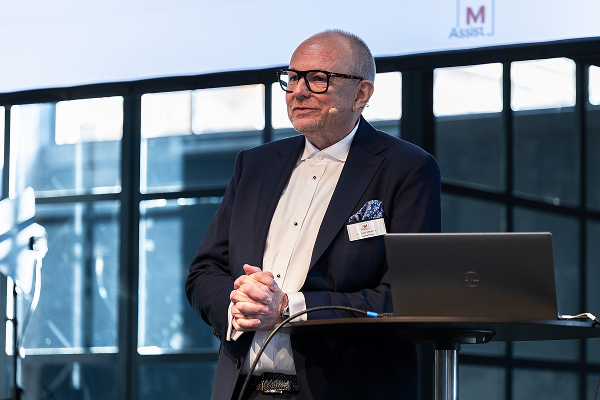
This is precisely the question addressed by the M Assist Future Lab 2026. On March 3rd and 4th, 2026, more than 100 decision-makers from the care sector, industry, technology and health insurance providers gathered in Cologne to analyze market shifts, evaluate future scenarios and define priorities for their own organizations.
"Development is also moving faster and faster. That’s why you shouldn't be afraid of the future changing more quickly – you just have to start becoming a part of it."
Ben Bake, Managing Director, aiutanda HTM Hilfsmittel & Therapiemanagement GmbH
The Future Lab is a biennial strategy and industry event hosted by M Assist for decision-makers in the healthcare sector. It focuses on the future of homecare, medical supply stores, assistive technology, medical devices and digital healthcare. The format combines market analysis, future scenarios and concrete options for action for companies that want to actively shape developments in the healthcare market rather than just observe them.
• Interdisciplinary perspectives on the market, care, technology, regulation and data
• Practical content with a focus on feasibility and strategic relevance
• Insights for strategy, processes, investments, and new business models

The Future Lab is aimed at executives and managers in homecare, medical supply, medical technology, digital healthcare, health insurance and related technology sectors. The format is particularly relevant for companies that need to evolve their strategic position in the healthcare market in the face of digitalization, regulatory change, and increasing pressure for efficiency.
M Assist defines the reality gap as the divide between what is already technologically, strategically and organizationally possible and what companies actually implement in day-to-day care. This gap describes one of the central bottlenecks in the healthcare market: many options are known, but only a fraction are consistently translated into processes, structures and services.
Future Lab 2026 addressed the topics that will strategically shape healthcare companies in the coming years:
• Backcasting and strategic visioning instead of linear trend extrapolation
• Market dynamics in the medical supply sector and new growth areas
• AI in healthcare, interoperable systems and patient-centered processes
• Telematics infrastructure and practical implementation hurdles
• AI agents in daily business and concrete applications in core processes
• Demographic change, baby boomers and omnichannel strategies
• Robotics, automation, data strategy and cyber security
• Resilience, decision-making capability and agility in uncertain market phases
For companies in homecare, medical supply retail and medical technology, the content of Future Lab 2026 can be distilled into seven key insights:
The market is growing, but what matters is not the overall growth, rather the question of in which segments and channels sustainable value creation is taking place.
Business perspective: Companies should take a closer look at where margins, differentiation and long-term potential are actually generated.
The online share of the medical supply market is still relatively low. However, this does not offer protection; rather, it is a clear indicator of impending changes in how customers interact with the market.
Business perspective: Omnichannel strategies, digital accessibility and new routes to market will continue to gain importance.
Those who derive the future solely from the past often remain trapped in the status quo. Future-proof companies develop a clear vision and derive specific capabilities, investments and priorities from it.
Business perspective: Strategic planning should be driven more by the desired future vision than by historical patterns.
It is not the use of individual tools that makes the difference, but their integration into daily operations. AI becomes relevant when it improves core processes, reduces errors and provides targeted relief for employees.
Business perspective: The focus should be on clearly defined use cases with measurable benefits.
A few well-defined pilot projects with a solid business case, clear KPIs and defined responsibilities often create more impact than large-scale AI or digital programs that lack prioritization.
Business perspective: Success in implementation comes from clarity, focus, and consistent translation into concrete applications.
Data security, stable digital infrastructure and vendor dependency are not isolated IT issues. They are integral to the strategic management of healthcare companies.
Business perspective: Executives should view cyber security as an integral part of resilience, performance and future-proofing.
Many companies already know what needs to be done. The real difference is made where priorities are clearly set, decisions are made and changes are consistently translated into processes.
Business perspective: Competitive advantages are not created by insight alone, but above all by the strength of execution.
The content from the Future Lab 2026 remains relevant because it provides a structured overview of key developments in healthcare. From AI and data strategy to omnichannel approaches, cyber security, resilience and digital infrastructure, these topics will decisively shape the competitiveness of companies in the coming years.
The goal of the Future Lab is to prepare participants as effectively as possible for the future by deliberately covering a broad spectrum of topics, ranging from the market and patient care to technology, data, security, and leadership.
The feedback from our participants shows that this approach works:
“Great selection of topics you’ve put together. A really wide spectrum. I took a lot away for myself. Very inspiring.”
Lars Kieroth, Managing Director of HODEY
The crucial question is no longer whether the healthcare market is changing. The crucial question is how companies can translate these changes more quickly into clear priorities, robust processes and future-ready offerings.
Those who recognize their own reality gap early and address it systematically create the foundation for greater competitiveness, better management and care that is more consistently aligned with market demands.
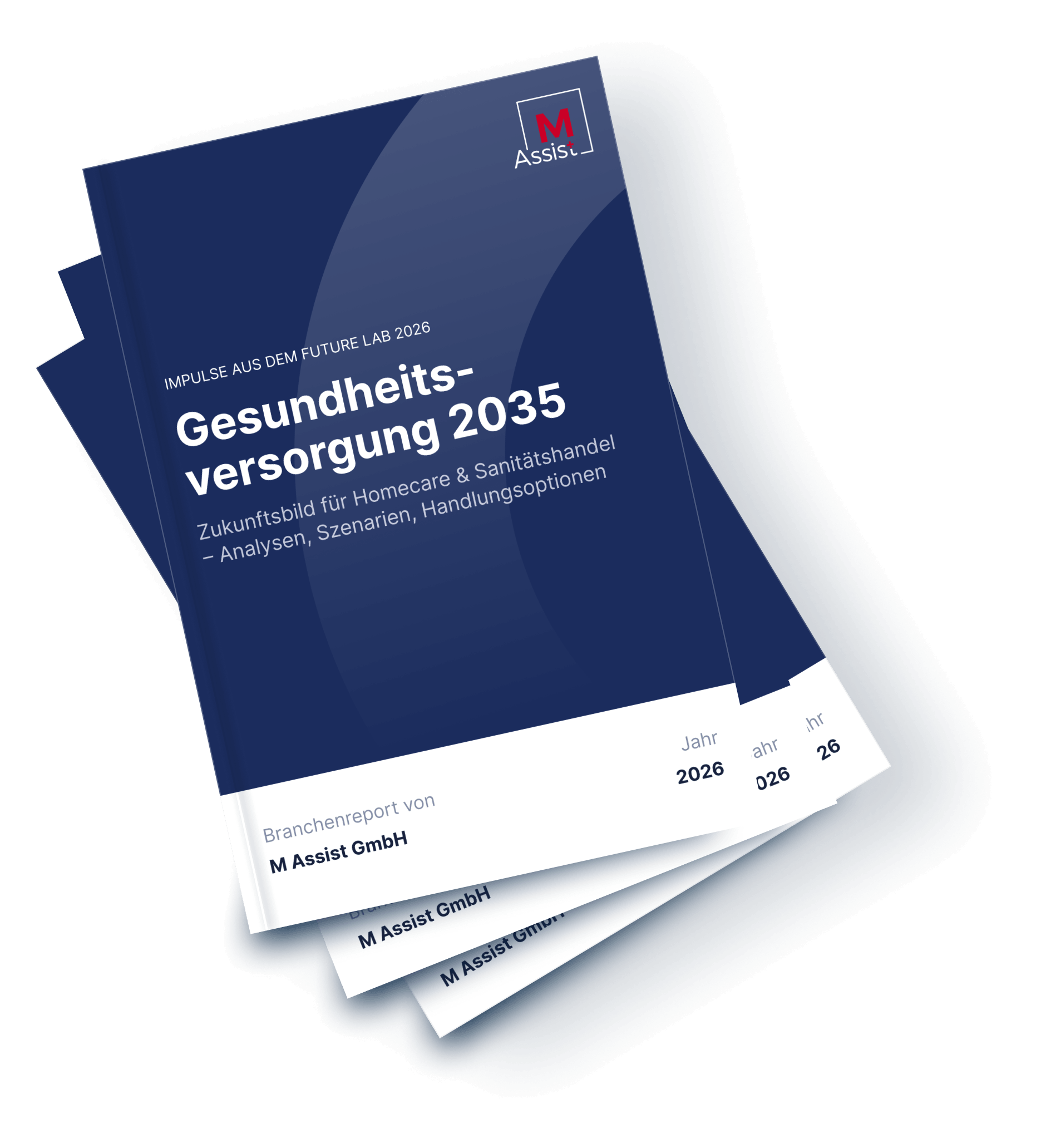
If you would like to delve deeper into the content of Future Lab 2026, our industry report, "Insights from Future Lab 2026 – Healthcare 2035," provides a detailed summary of the presentations, key market analyses, and concrete options for action for companies in homecare, medical supply retail, and the broader healthcare sector.
Download the industry report for free
The next Future Lab will take place in 2028. If you want to gain a structured understanding of developments in homecare, medical supply retail, medical technology and digital healthcare – and play an active role in shaping them – be sure to keep the next Future Lab on your radar.
Sign up now to be the first to receive an invitation to Future Lab 2028!
Diesen Artikel teilen.


Mehr entdecken